
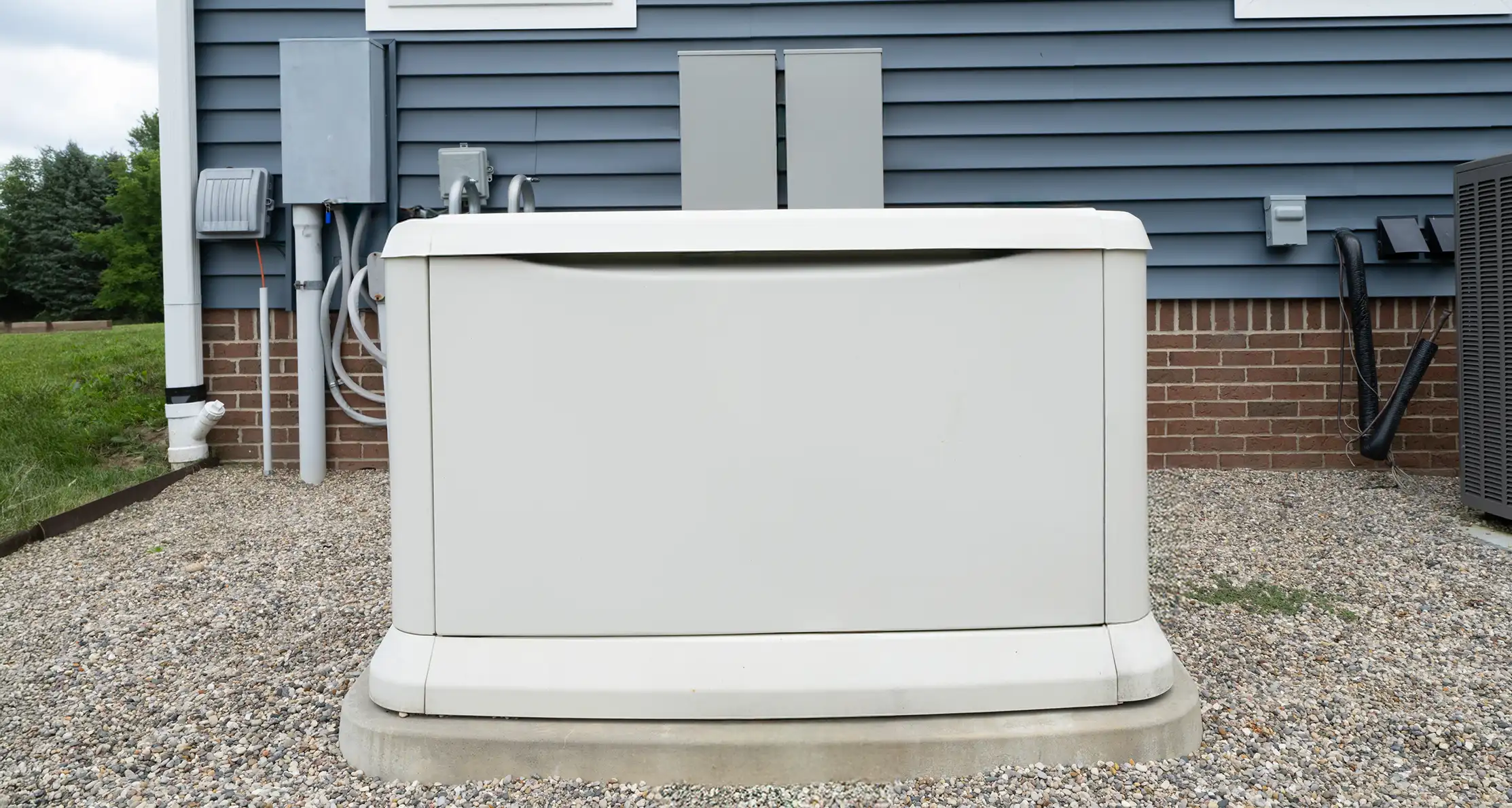
A generator sized right keeps the house cool through an outage, and one sized wrong trips the moment the AC starts. If you’re learning how to size a home standby generator for Texas summers, start with the AC, because it’s the load that decides the rest. The math isn’t hard, and the size of your house matters less than what’s plugged into it.
What the Sizing Guides Get Right
The big generator makers size a home standby unit the same basic way. You list what should run in an outage, add up what each item draws, and leave some room on top. Cummins lays out that math for homeowners.
Anything with a motor pulls its running watts once it’s turning. Getting it moving takes a brief surge called starting watts. The generator has to cover the biggest starting surge in the house while everything else keeps running.
Put that list on paper and you’ve got a sizing worksheet. Every list includes the refrigerator, but it’s rarely the item that decides the size.
Why the Compressor Calls the Shot Here
An essentials plan in a typical sizing guide covers the refrigerator plus a few lights and outlets. That works in a mild climate. In Texas summer heat, a house gets hard to live in without air, so the AC jumps to the top of the list.
Most homes have no bigger motor than the central AC compressor. When it starts, it pulls a surge several times its steady draw, then settles down. In a Texas summer, that one surge is usually the number that sets the kilowatt rating. A generator that can’t cover it will sag, and the AC may stall or the generator may trip.
Sizing off square footage alone skips the only list that matters, since two houses the same size can hold very different equipment. We start with what you want running and work out from there.
Size the generator for the hardest moment your house will ask of it. In Texas, that’s the AC starting on a hot afternoon.
Soft Start Kits and Load Managers
You can handle that surge without buying a giant generator. A soft start kit wires into the outdoor AC unit and eases the compressor up to speed. The surge it asks of the generator gets much smaller. Generac’s sizing guide pairs a mid-sized generator with a soft start or a load manager for this exact reason.
The other tool is load shedding. A load management module sits on a big circuit, like a second AC or the pool pump. When the generator nears its limit, the module switches that circuit off for a while. With the big loads taking turns, a mid-sized unit can carry a house that would otherwise need a much larger one. The dryer just waits its turn.
Neither tool rescues a generator that’s simply too small.
What Whole House Coverage Really Means
With whole house coverage, the generator feeds your main panel through an automatic transfer switch. That switch moves the house from the grid to the generator when the power drops. Every circuit works during an outage, but not every appliance can run at once.
The other approach backs up only essential circuits. A smaller generator feeds a separate panel holding the loads you picked, often the fridge and one AC.
Either setup leaves a short blink of darkness while the generator starts and the switch moves over. One of our generator customers noticed that brief gap before the unit picked up the load. They were right that a computer still needs a UPS, a small battery backup under the desk, to ride through it.
Sizing Mistakes That Leave You Short
Where 22kW and 26kW Units Fit
Home standby lineups include sizes like 22kW and 26kW, but your list decides which one fits, or whether you need something else. The number in the model name isn’t always what you get. Most standby units put out less on natural gas than on propane, because natural gas carries less energy per cubic foot. Electricians call that gap natural gas derating.
If your house gets natural gas from CPS Energy, size against the natural gas rating on the maker’s spec sheet, not the propane number. The gas meter also has to feed the generator plus your other gas appliances, and if it can’t, the gas utility has to upgrade it.
Sizing is the first step of every job that comes through our Electric Generator Shop, and the permit, inspection and service follow. We sell, install and service home standby generators, and we install the transfer switch that goes with each one.
Size for the Next Uri, Too
Winter Storm Uri showed that a long outage here can hit in February as well as August. The University of Texas Energy Institute studied how those blackouts happened across the state’s grid.
In that kind of cold, a heat pump leans on electric heat strips, backup coils that take over when it’s too cold for the heat pump. Those strips can pull as much as the AC does in summer, sometimes more. Even a tight, well-insulated house loses heat over a long outage, so the strips keep cycling on. If your home heats with electric strips, the winter load goes on the worksheet next to the AC. A gas furnace is easier, since the generator only runs its blower and controls.
Gather These Before Anyone Quotes a Size
You can do a good share of the sizing work before anyone comes out. Take a photo of the data plate on your outdoor AC unit. The locked rotor amps on that plate, often marked LRA, show how hard the compressor hits when it starts.
What to Have Ready
Getting the Size Settled
Call (726) 268-9306 and tell us what you want running when the grid goes down. We’ll go over your list and explain the size options before any work starts. On the install, we pull the permit and schedule the inspection.
We answer the phone 24/7. If your lights are already out, the situation decides whether the crew heads over that night or makes things safe and finishes later.
Every generator job runs under a licensed master electrician, Jamaer Hopes, TDLR #514109.